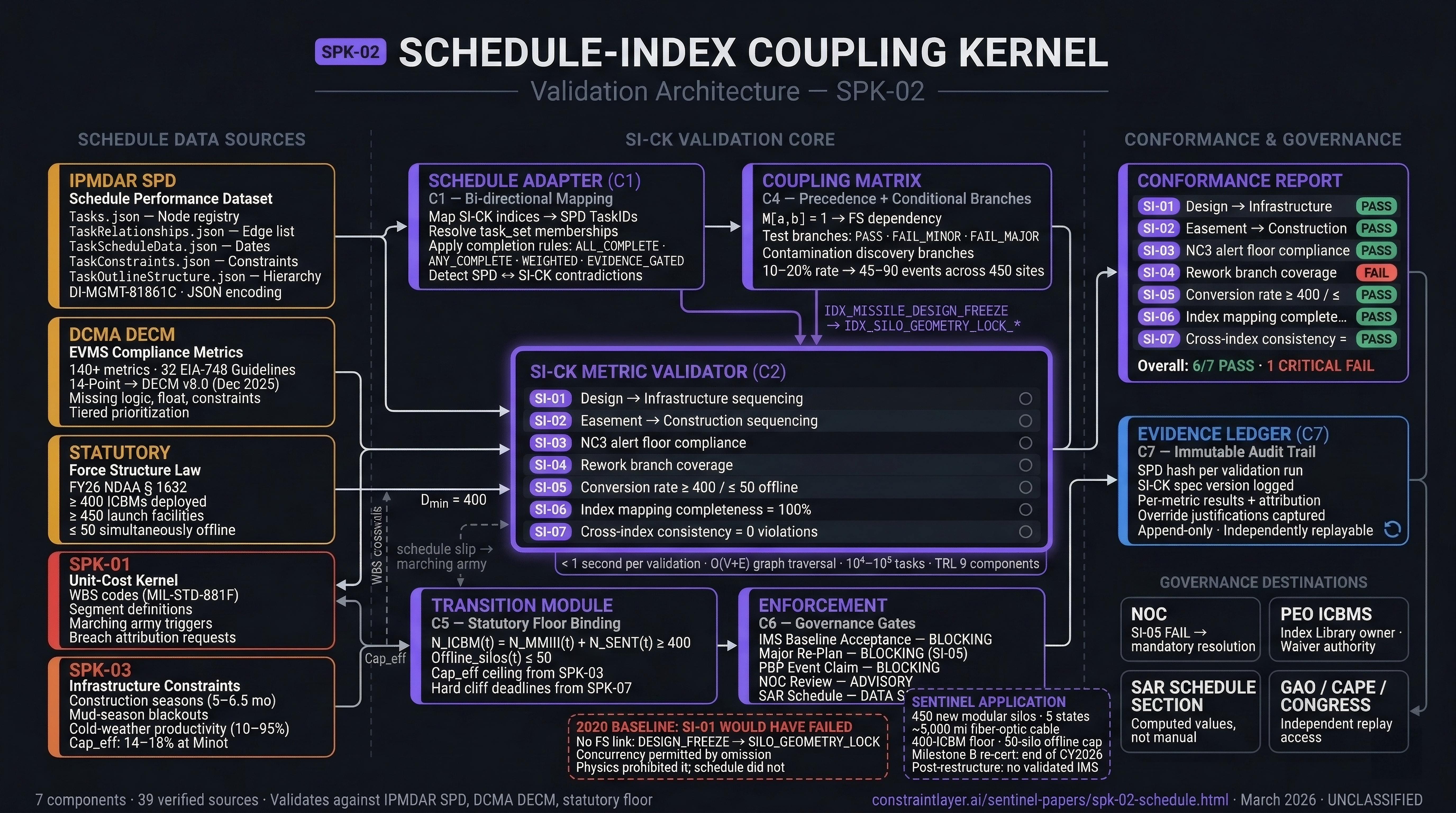
The Sentinel ICBM program's 2024 critical Nunn-McCurdy breach occurred despite modern schedule management tools. The enforcement infrastructure exists—IPMDAR schema validation, DCMA's 140+ compliance metrics, Performance Based Payments, DFARS withholds. What does not exist is a Sentinel-specific conformance specification ensuring the re-baselined IMS encodes the physical dependencies the 2020 baseline omitted. SI-CK provides that specification: a validation layer that makes schedule dependencies computationally verifiable against engineering reality.
The Schedule-Index Coupling Kernel (SI-CK) is SPK-02 of the Sentinel Recovery Architecture. It is not a new scheduling tool, not a new enforcement mechanism, and not a replacement for existing governance. IPMDAR schema validation rejects malformed schedule data at upload.[9] DCMA's 140+ EVMS Compliance Metrics (DECM) detect logic flaws algorithmically.[10] Performance Based Payments gate contractor cash flow on milestone completion.[11] DFARS 252.242-7005 authorizes payment withholds for business system deficiencies.[12]
What does not exist is a Sentinel-specific conformance specification that ensures the program's re-baselined Integrated Master Schedule encodes the physical and programmatic dependencies the 2020 baseline omitted.
In February 2026, the Air Force announced the restructured program: 450 new modular silos, approximately 5,000 miles of fiber-optic cable, across 32,000 square miles in five states. A prototype silo broke ground at Promontory, Utah on February 13, 2026.[7] Milestone B re-certification is expected by end of calendar year 2026; IOC is targeted for the "early 2030s."[8]
The GAO found that the program's master schedule had "many deficiencies" and was under review.[4] Post-restructuring, the program operates without a validated lifecycle IMS while developing a new acquisition baseline.
SI-CK targets two closure mechanisms:
IDX_FIRST_FLIGHT_OPERATIONAL delayed from t₁ to t₂ because predecessors IDX_SILO_GEOMETRY_LOCK_WARREN and IDX_NC3_FIBER_OVERLAY_SEGMENT_A remained incomplete at t₁, with rework loop IDX_INTEGRATION_TEST_FAILURE_PATH active. Every schedule assertion maps to indices, predecessors, and conditional branches—not narrative.
Defense acquisition schedules present a paradox. They are simultaneously highly structured—thousands of tasks with explicit predecessors, successors, durations, and resource assignments—and fundamentally unreliable as predictive instruments. The structural integrity of a schedule can be perfect while its content validity is absent. A schedule passes every syntax check, every metric threshold, every compliance gate—and still fails to represent the physics of the program it purports to model.
Modern schedule management possesses substantial capability:
The enforcement infrastructure exists. What it enforces is whatever the program chooses to encode. A program can submit IPMDAR-compliant JSON, pass DCMA metric thresholds, and still harbor a schedule that does not reflect engineering reality—because the dependencies were never specified.
The gap between schedule capability and schedule content has produced documented failures across major programs.
GAO-14-322 (March 2014) found that challenges in developing and testing mission systems software—including software delivery delays, limited capabilities upon delivery, and the need to retest multiple versions—risked delaying expected warfighting capabilities by as much as 13 months.[23]
GAO-15-364 (April 2015) found that Block 3F software was delayed and constituted a "significant risk area," with delays in preceding blocks forcing reallocation of personnel from Block 3F development. Aircraft were being delivered with immature software, creating concurrency risk where the Department continued buying hardware while the software controlling it remained in development.[24]
The most direct finding came in GAO-21-105282 (July 2021), synthesizing findings from GAO-21-226: the F-35 Block 4 modernization program lacked a "knowledge-based schedule" and did not have a "fully logic-driven schedule" with established dependencies between activities, preventing accurate prediction of completion dates or assessment of delay impacts.[25]
GAO-12-366 (March 2012) found that the KC-46 schedule was "success-oriented" and allowed for "little, if any, schedule slip"—meaning any technical challenge would immediately cause delivery delays.[26]
GAO-15-308 (April 2015) found that Boeing's flight test plan was based on "optimistic" assumptions that did not adequately account for rework, retesting, or the correction of deficiencies found during testing.[27]
GAO-19-480 (June 2019) documented the consequences: the program was nearly three years behind schedule. The Remote Vision System (RVS) had critical deficiencies in lighting and image distortion. Rather than resolving deficiencies before delivery, the Air Force began accepting aircraft with known critical deficiencies in January 2019, planning to develop fixes and retrofit approximately 106 aircraft over several years.[28]
The LGM-35A Sentinel program entered Engineering and Manufacturing Development in September 2020 with a $13.3 billion contract to Northrop Grumman.[29][30] The acquisition strategy assumed significant reuse of existing Minuteman III infrastructure—silos, launch control centers, and copper cabling.[6]
In January 2024, the Air Force notified Congress that Sentinel had triggered a critical Nunn-McCurdy breach.[31] Following the Department's review, announced July 8, 2024:[1]
The cost explosion occurred because the original acquisition strategy assumed refurbishment of existing Minuteman III silos. A pilot conversion at Vandenberg Space Force Base revealed "unknown site conditions" posing "unacceptable risks to cost, schedule and weapon system performance."[6] Sentinel is confirmed as larger than Minuteman III, and the size differential necessitates different bore diameter and maintenance access configurations than 1960s-era silos can accommodate.[7][32]
Three figures circulate in public reporting. They represent different measurements of the same program:
$77.7 billion: Original September 2020 Milestone B baseline in Base-Year 2020 dollars.[3]
$95.8 billion: The same baseline in Then-Year dollars, accounting for projected inflation. This is the correct figure for Nunn-McCurdy breach calculation.[33]
$140.9 billion: Revised total acquisition cost in Then-Year dollars, announced July 8, 2024.[1]
Comparing $77.7 billion (BY2020) directly to $140.9 billion (TY) is invalid—it crosses dollar-year bases. The correct then-year comparison is $95.8 billion to $140.9 billion. As of March 2026, no new cost estimate reflecting the February 2026 restructure has been published.[2]
The Department cited "ineffective systems engineering and incomplete basic system design" at the time of the Milestone B award.[5] The 2020 baseline embedded concurrent design and construction without encoding the physical constraint that launch facility specifications depend on missile design maturity. Sentinel's larger dimensions, shock isolation requirements, and maintenance access patterns dictate silo specifications.[6][7]
IDX_MISSILE_DESIGN_FREEZE → IDX_SILO_GEOMETRY_LOCK — then the schedule would have shown that construction planning for silos could not begin until missile design was complete. The "concurrent" approach would have registered as a constraint violation. No such relationship existed. The physics prohibited concurrency; the schedule did not.IDX_MISSILE_DESIGN_FREEZE and all IDX_SILO_GEOMETRY_LOCK_* nodes. The 2020 IMS contained no such relationship—silo construction planning proceeded concurrently with missile design maturation, with no encoded dependency between them. SI-01: FAIL. Baseline rejected. The enforcement mechanisms were present. The conformance rule that would have triggered them was not.
Following the July 2024 certification, Milestone B approval was rescinded. In February 2026, the Air Force announced the restructured program:[7][8]
Officials stated that new construction "should be faster and less expensive because the new silos are modular and the work will not need to be done on silos that are currently being used."[7] No demonstrated production rates exist for either the modular silo methodology or the corridor construction approach.[7][32]
SI-CK operates on existing data infrastructure. The IPMDAR, governed by Data Item Description DI-MGMT-81861C (approved August 30, 2021), replaced the legacy IPMR with a data-centric exchange standard requiring JSON encoding.[9][18] The transition from XML to JSON was completed with DI-MGMT-81861B in March 2020.[18]
The IPMDAR comprises three components: the Contract Performance Dataset (CPD) for cost, budget, and labor data; the Schedule Performance Dataset (SPD) for IMS network logic, task attributes, and resource assignments; and the Performance Narrative Report for contextual analysis.[9]
The SPD File Format Specification and Data Exchange Instructions are publicly available from the OUSD(A&S) Acquisition Data and Analytics website.[19][34]
Tasks.json (Node Registry): Each activity in the IMS is represented as an object. Key fields include ID (unique persistent identifier), Name (descriptive title), and WBSElementID (foreign key to WBS structure, linking to UC-BCK cost elements).[19]
TaskScheduleData.json: Date and duration fields: TaskID (foreign key to Tasks.json), BaselineStartDate, BaselineFinishDate, ActualStartDate, ActualFinishDate, RemainingDuration (working days), PercentComplete (0–100).[19]
TaskConstraints.json: Constraint data using ConstraintTypeID (numeric enumeration covering ASAP, ALAP, SNET, SNLT, FNET, FNLT, MSO, MFO).[19]
TaskRelationships.json (Edge List): Dependencies encoded as directed edges: PredecessorTaskID (source node), SuccessorTaskID (target node), RelationshipTypeID (1=FS, 2=SS, 3=FF, 4=SF), Lag (duration), and LagCalendarID.[19]
TaskOutlineStructure.json (Hierarchy): Summary task relationships (parent-child) with TaskID, ParentTaskID, and OutlineLevel. This separation allows SI-CK to query logic (who drives whom) independently of reporting hierarchy (who rolls up to whom).[19]
When a contractor uploads IPMDAR JSON to the EVM Central Repository, automated validation scripts execute. Files failing validation are rejected—not "received with warnings" but technically non-delivered under the CDRL.[9]
Structural validation checks include: unique primary keys, referential integrity for foreign keys, ISO 8601 date compliance, controlled vocabulary for enumerated fields, non-null constraints on required fields, and directed acyclicity in the relationship graph.[19]
The DCMA introduced the 14-Point Schedule Health Assessment in 2005 as a standard for evaluating IMS quality. The assessment measured 14 specific schedule health indicators including missing logic, leads, lags, relationship types, hard constraints, high float, negative float, high duration, invalid dates, resources, missed tasks, critical path test, Critical Path Length Index, and Baseline Execution Index.[20] The 14-Point Assessment evolved into the DCMA EVMS Compliance Metrics (DECM) framework between 2016 and 2019, expanding from 14 schedule-specific tests to over 140 metrics covering all 32 EIA-748 Guidelines—including organizational structure, work authorization, budget traceability, and indirect costs in addition to schedule health.[20][21]
| Metric ID | Name | Threshold |
|---|---|---|
| 06A202 | Missing Logic | ≤ 5% |
| 06A204 | Dangling Logic | ≤ 5% |
| 06A206 | Leads (Negative Lag) | 0 |
| 06A302 | Excessive Lag | Flag for review |
| 06B102 | Hard Constraints | ≤ 5% |
| 06B202 | Soft Constraints | Flag for review |
| 06C102 | High Float (>44 days) | Flag for review |
| 06C202 | Negative Float | Track trend |
| 06D102 | Critical Path Test | Completion moves correspondingly |
| 06D202 | Critical Path Length Index (CPLI) | ≥ 0.95 |
Performance Based Payments (PBP): Governed by DFARS Subpart 232.10, PBP ties contractor cash flow to objective milestone achievement. When a contractor claims a PBP event, the Administrative Contracting Officer reviews the IMS: are all predecessor tasks complete? Were any tasks completed out of sequence? Is the logic path sound? If any check fails, the event cannot be claimed.[11]
DFARS 252.242-7005 Business System Withholds: Covers six contractor business systems: Accounting, Earned Value Management, Estimating, Material Management and Accounting, Property Management, and Purchasing. A "significant" deficiency materially affects the ability to rely on reported data, persists after notification, or affects multiple contracts. Withholding: 5% for one significant deficiency, maximum 10% for two or more.[12]
EVMS Deficiency: Persistent SI-CK conformance failures could be documented as EVMS significant deficiencies under DFARS 252.234-7002, enabling withholding and creating financial incentive for compliance beyond milestone-specific PBP gates.[35]
Section 1632 of the Fiscal Year 2026 National Defense Authorization Act permanently codified a statutory floor into Title 10 of the U.S. Code: not fewer than 400 intercontinental ballistic missiles operationally available and deployed among not fewer than 450 operational launch facilities.[13][14] This replaces temporary, uncodified minimums that had been inserted into every annual NDAA since Fiscal Year 2017.[13]
This is not policy guidance. It is law. The Secretary of Defense cannot reduce deployed ICBMs below 400, regardless of acquisition schedule status.
GAO-25-108466 documents the challenge: Sentinel delays require careful planning to maintain strategic deterrent during concurrent operations and extended MMIII operation.[4]
The 400-missile floor currently exists as law binding retirement decisions. It does not exist as a schedule-level constraint that rejects IMS variants proposing conversion patterns that would violate the floor. A program office could propose a conversion schedule that temporarily drops operational ICBM count below 400. Current tools would not automatically flag this as invalid. SI-CK embeds this constraint in schedule validation.
Scenario: Q1 2031 Conversion Proposal
Given (end of Q4 2030): N_MMIII = 420, N_SENT = 0 (pre-IOC), N_ICBM = 420.
Proposed for Q1 2031: CONVERSIONS = 35, NEW_OPERATIONAL = 10.
Result: N_ICBM(Q1-2031) = (420 − 35) + (0 + 10) = 395. Below 400 floor. SI-05: FAIL.
Additionally: If 35 silos offline for conversion plus any in maintenance exceeds 50: Offline constraint violated.
Under the February 2026 restructure, new silos are built on government-owned "swing space" adjacent to operational MMIII silos.[7] The extent of available government land remains "under review."[7] Defense Explosives Safety Regulation 6055.09 and AFMAN 91-201 mandate a 1,200-foot Inhabited Building Distance standoff from operational ICBM launch facilities for construction crews.[36]
Whether construction on swing space counts against the 50-silo offline constraint is unresolved. SI-CK treats it as binding until the determination is made, consistent with SPK-07 guidance.[14]
MMIII sustainment has absolute time limits that bound how late SI-CK indices can slip:[14]
| Cliff | Earliest | Latest |
|---|---|---|
| Propellant oldest (HTPB scenario) | ~2023 | ~2030 |
| NS-50 guidance exhaustion | ~2028 | ~2035 |
| Propellant youngest (any binder) | ~2034 | ~2049 |
If SI-CK indices slip beyond SPK-07's "Major" threshold (>2 years from new baseline), MMIII Solid Rocket Motor replacement (PRP-2) and guidance recapitalization (NS50_RECAP) are triggered—neither of which has a program of record or funded budget line.[14]
SI-CK comprises seven components, all using mature technology at TRL 9: JSON parsing and schema validation, graph algorithms, constraint satisfaction, rule engines, linear programming, workflow engines, state machines, and append-only stores. Computational requirements are modest: input of O(104–105) tasks, graph traversal O(V+E), execution time well under one second per validation run.[19]
Function: Bi-directional mapping between SI-CK symbols and IPMDAR SPD structures. Each SI-CK index is defined by a mapping record specifying: a unique index_id (e.g., "IDX_SILO_GEOMETRY_LOCK_WARREN"), a descriptive name, the set of SPD TaskIDs comprising the index (task_set), a completion rule, WBS mapping codes for UC-BCK integration, and program segment assignment.[19]
Completion Rule Types:
| Type | Semantics |
|---|---|
| ALL_COMPLETE | All tasks in task_set have ActualFinishDate |
| ANY_COMPLETE | At least one task has ActualFinishDate |
| WEIGHTED | Weighted average of PercentComplete ≥ threshold |
| EVIDENCE_GATED | Task completion plus external evidence satisfied |
The adapter also detects contradictions—SPD relationships that violate SI-CK constraints, such as a successor task starting before its required predecessor completes.
SI-CK adds seven program-specific metrics to the DECM framework:
Design-Infrastructure Sequencing
IDX_MISSILE_DESIGN_FREEZE must have FS successor to all IDX_SILO_GEOMETRY_LOCK_*
MANDATORY
Easement-Construction Sequencing
Each IDX_EASEMENT_ACQUIRED_[X] must have FS successor to IDX_CABLE_CORRIDOR_CONSTR_START_[X]
MANDATORY
NC3 Alert Floor Compliance
IDX_NC3_FIBER_OVERLAY_* cannot start unless IDX_MMIII_ALERT_FLOOR_MET_* = true
PER D_min
Rework Branch Coverage
All IDX_*_TEST nodes must have at least one conditional successor path
MANDATORY
Conversion Rate Compliance
Offline_silos(t) ≤ 50 and N_ICBM(t) ≥ 400 for all t
PER FORMULA
Index Mapping Completeness
All SENTINEL_INDEX_LIBRARY indices mapped to SPD task_sets
100%
Cross-Index Consistency
No TaskRelationships contradict COUPLING_MATRIX
0 VIOLATIONS
The Sentinel Index Library is the canonical list of lifecycle milestones and dependency templates, organized in five categories:
Category 1: Missile System (MISSILE_SYS): Requirements locked → PDR → CDR → Design Freeze → Stage 1/2/3 Motor Qualification, PBV Qualification, Guidance Qualification → First Flight Test → Flight Test Series Complete. All qualification indices depend on Design Freeze; First Flight Test depends on all qualification indices.
Category 2: Ground Infrastructure (GROUND_SYS) — Per Wing: For each wing (Warren, Malmstrom, Minot): Silo Geometry Lock, LCC Design Lock, and MAF Design Lock all depend on IDX_MISSILE_DESIGN_FREEZE. Per corridor/segment: Easement Acquired → Environmental Cleared → Cable Corridor Construction Start → Construction Complete. Per facility: Construction → Outfitting → Ready. Easement indices are decomposed to segment level because a single holdout parcel blocks an entire corridor path.[36]
Seasonal Binding (from SPK-03): Ground infrastructure indices are bounded by construction season windows: Warren (May 1 – Nov 15, 6.5 months), Malmstrom (May 1 – Oct 31, 6 months), Minot (May 15 – Oct 15, 5 months). Mud-season logistics blackouts (March 1 – mid-May) further constrain material delivery.[36]
Category 3: NC3 Integration (NC3_INTERFACE): Architecture Locked → Fiber Overlay per wing/segment (requires cable corridor complete + MMIII alert floor met) → Integration Test phases → NC3 Certification.
Category 4: Warhead Integration (WARHEAD_SYS): MMIII Decommission per batch → W87-0 Warhead Harvest → Warhead Handoff → Sentinel Armed. W87-1 availability is an external DOE/NNSA dependency.
Category 5: Transition and Operations (TRANSITION): MMIII Alert Floor per wing/period, Silo Conversion per silo ID, Wing IOC/FOC per wing, System IOC (first wing), System FOC (all wings).
C4: Extended Coupling Matrix Engine. For non-test dependencies, the coupling matrix is a precedence relation: M[a,b] = 1 implies index b cannot complete until index a completes, encoded as RelationshipTypeID = 1 (FS) with lag ≥ 0. For test indices, SI-CK requires explicit conditional branches per the JA CSRUH methodology[22]: outcomes include PASS (proceed), FAIL_MINOR (rework and retest), FAIL_MAJOR (design revision, rework, retest). For ground infrastructure, SI-CK requires contamination/cultural resource discovery branches: SPK-03 documents a 10–20% discovery rate per site, yielding 45–90 expected events across 450 sites—a near-certainty at program level.[36]
C5: Transition Rate Constraint Module. Formal specification: N_ICBM(t) = N_MMIII(t) + N_SENT(t) ≥ 400 for all t. LF_active(t) ≥ 450. Offline_silos(t) ≤ 50. D_min = 400 (statutory floor per FY26 NDAA Section 1632).[13] Physical production rate ceiling from SPK-03: at the most constrained wing (Minot, 91st MW), effective construction capacity is approximately 14–18% of nominal after weather, logistics, productivity, travel, and security multipliers compound.[36]
C6: Enforcement Integration Layer. Status is derived from SPD data and evidence conditions, not asserted. Manual overrides require authenticated identity, justification, and approval. Governance integration: IMS Baseline Acceptance (blocking), Major Re-Plan Approval (blocking for SI-05), PBP Event Claim (blocking via PBP logic), NOC Review (advisory with escalation), SAR Schedule Section (data source).
C7: Evidence Ledger. Records all validation runs, results, overrides, and adjudications. Entries include SPD hash, SI-CK specification version, per-metric results, and attribution. Any authorized party can replay a historical validation by retrieving the archived SPD and re-executing against the logged specification version. This enables GAO, CAPE, or Congressional staff to independently verify conformance status.
Nuclear Oversight Committee (NOC): Established in Fall 2023—before the formal January 2024 Nunn-McCurdy breach notification—as a proactive step to address emerging Sentinel challenges. Co-chaired by the most senior leaders of the Department of the Air Force, overseeing the nuclear enterprise including strategic bombers, land-based ICBMs, and nuclear command and control.[15][37] SI-CK conformance reports flow to the NOC; SI-05 (D_min) failure cannot be approved without resolution.
Program Executive Officer for ICBMs (PEO ICBMs): The Air Force established a dedicated PEO for ICBMs at the Air Force Nuclear Weapons Center, serving as the portfolio owner for both Minuteman III and Sentinel programs.[16] PEO ICBMs is the functional owner of SI-CK—maintaining the Sentinel Index Library, defining conformance criteria, ensuring CDRL inclusion, exercising waiver authority for non-critical violations, and escalating unresolved critical violations to NOC.
Air Force Nuclear Weapons Center (AFNWC): AFNWC at Kirtland AFB remains the institutional host for nuclear acquisition and sustainment, including the ICBM Systems Directorate at Hill AFB.[17] Note: a 2024 proposal to restructure AFNWC into a 3-star "Air Force Nuclear Systems Center" was canceled in December 2025 as part of the rollback of major portions of the Re-Optimization for Great Power Competition initiative.[38]
UC-BCK (SPK-01): Schedule indices connect to cost metrics through shared WBS codes (MIL-STD-881F) and common program segment definitions (MISSILE_SYS, GROUND_SYS, NC3_INTERFACE). When SI-CK detects schedule slip, UC-BCK computes marching army costs—Level of Effort activities that continue burning budget during delay. When UC-BCK computes a Nunn-McCurdy breach, SI-CK provides the schedule decomposition: which indices are delayed, which segments have slip.
GI-PCK (SPK-03): Physical constraints bound SI-CK's ground infrastructure indices: construction season windows (5–6.5 months by wing), mud-season blackouts (9–10.5 weeks), cold-weather productivity degradation (10–95%), clearance pipeline throughput (5–12 months; GAO-26-108838[39]), seasonal workforce dissolution, linear network vulnerability, and the compounding cascade (14–18% effective capacity at Minot).[36]
UC-BCK computes Nunn-McCurdy cost metrics from FlexFile source data. When SI-CK detects schedule slip, UC-BCK computes marching army costs. When UC-BCK computes a breach, SI-CK provides the schedule decomposition: which indices are delayed, which segments have slip, and what total schedule-driven cost growth results.
GI-PCK documents the physical constraints that bound SI-CK's ground indices: construction season windows (5–6.5 months by wing), mud-season blackouts, cold-weather productivity degradation (10–95%), and the compounding cascade reducing effective capacity to 14–18% at Minot. SI-CK consumes these as bounding functions.
NC3 concurrent operations require alert floor compliance. SI-CK's SI-03 metric ensures NC3 fiber overlay cannot proceed unless MMIII alert floor is met at each wing. NC3 architecture lock depends on missile design freeze.
Schedule indices for NC3 fiber overlay and facility outfitting depend on cyber-surety validation gates. SI-CK's facility readiness indices cannot close without security certification of the digital infrastructure.
SI-CK requires conditional branching for all test indices (SI-04). Test failures trigger rework paths with duration distributions and successor paths feeding into JCL/SRA Monte Carlo simulation. Every test cell in TEA-K has a schedule impact path in SI-CK.
Hard cliff deadlines from SPK-07 bound how late SI-CK indices can slip. If indices exceed the "Major" threshold (>2 years from baseline), MMIII propellant replacement and guidance recapitalization are triggered—neither of which has a program of record. The 400-ICBM floor and 50-silo offline cap derive from SPK-07 parameters.
SI-CK must satisfy eight acceptance criteria to close the identified gaps. All remain unmet as of the current date.