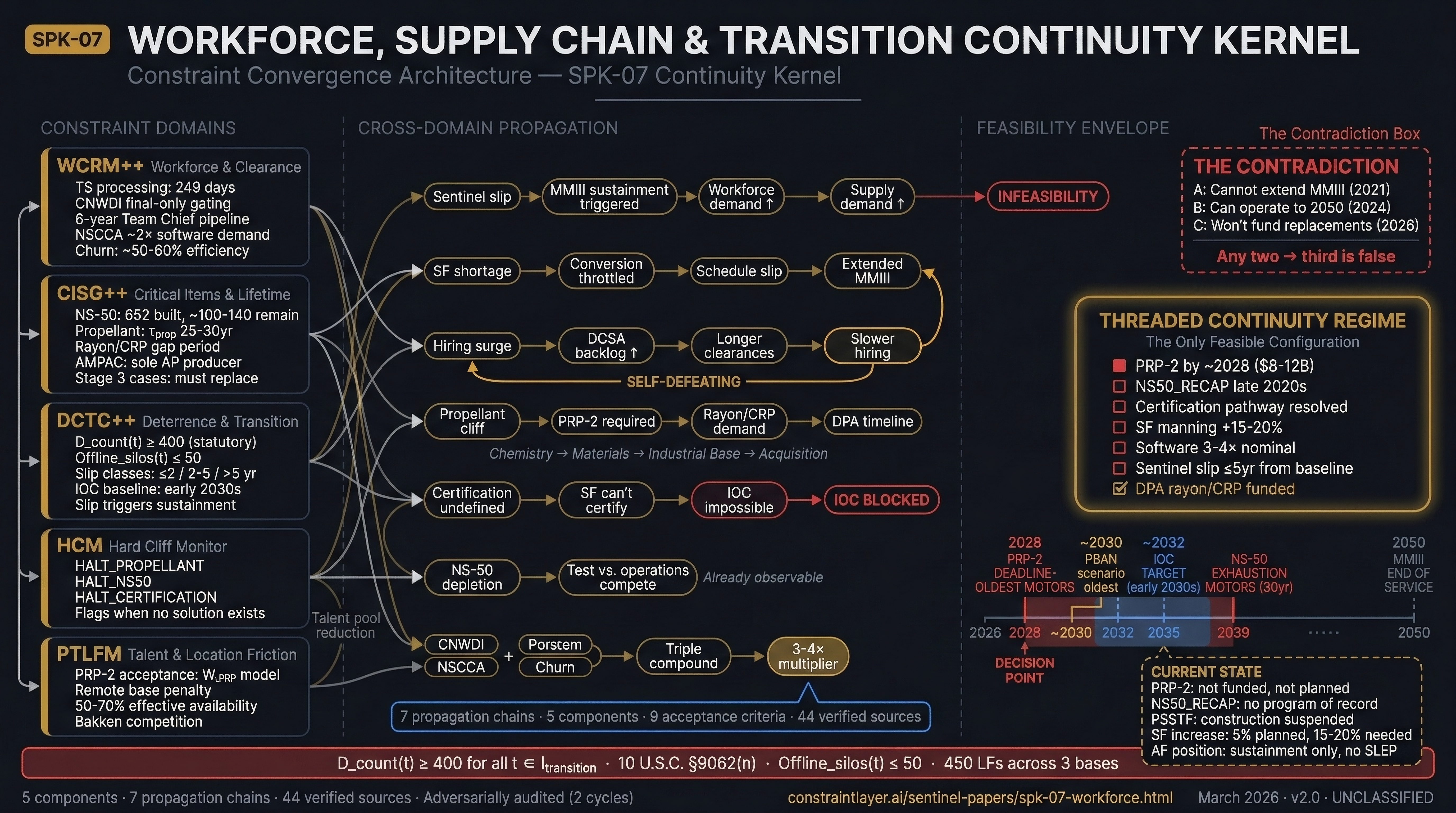
The United States is attempting to run two full-scale strategic missile programs simultaneously — sustaining Minuteman III through 2050 while fielding Sentinel — with an industrial base, workforce, and infrastructure sized for one. The Air Force assessed 2050 operation as "feasible" only if "entire subsystems" including propulsion and guidance are replaced.[2] Neither replacement program exists. Meanwhile, the propellant is aging toward a viability horizon that the Air Force's own assessment says requires action. Guidance spares are depleting — the Air Force is already reducing test launches to conserve parts.[13] The security certification pathway for Sentinel is suspended with no schedule. There is no viable path that both maintains 400 operational ICBMs and respects the Air Force's own 2050 feasibility conditions under current funding. WST-K identifies the only feasible configuration and the decisions that must be made by ~2028 — or the statutory requirement of 400 operational ICBMs[5] becomes physically impossible to maintain.
The January 2024 Nunn-McCurdy breach[1] — 81% cost growth to $140.9 billion — obscured a parallel crisis. GAO-25-108466[2] confirmed Minuteman III operation through 2050 is "feasible" but identified three unmitigated risk categories: parts obsolescence, workforce capacity constraints, and industrial base fragility. These are not independent — they create compounding failure modes where workforce shortages accelerate parts cannibalization, parts shortages force unsustainable maintenance tempos, and both delay Sentinel, extending MMIII requirements further.
ICBM wings logged over 2.4 million maintenance hours over five years — a 30% increase.[3] A further 25% increase is projected[4] over the remainder of the decade.
| Parameter | Value | Source |
|---|---|---|
| Statutory ICBM Floor | 400 operational | 10 U.S.C. §9062(n)[5] |
| Launch Facilities Required | ≥450 | §9062(n)[5] |
| Sentinel IOC Target | Early 2030s | Breaking Defense, Feb 2026[40] |
| MMIII Must Operate Until | ~2050 | GAO-25-108466[2] |
The Air Force has made three statements to Congress over five years. Each is documented. Each was made by named officials. Together, they are logically incompatible — any two being true makes the third false.
STRATCOM Commander Admiral Charles Richard stated[45] at a Defense Writers Group roundtable in January 2021: "You cannot life-extend Minuteman III… You're quickly getting to the point where you can't do it at all." AFGSC Commander General Timothy Ray told the Senate Armed Services Committee[46] in May 2021 that a SLEP would cost $38 billion more than building GBSD. This was the justification for Sentinel: the existing system is beyond saving, so fund the replacement.
When Sentinel breached at 81% and Congress asked what happens if Sentinel is late, the Air Force reversed. GAO-25-108466 reports[2] the Air Force assessed that operating Minuteman III through 2050 is "feasible" — but only if "entire subsystems" including propulsion and guidance are replaced. GAO characterized this as carrying "significant risk"[43] with "significant unknowns" in aging component performance.
AFGSC Commander Lt. Gen. Gebara stated:[41] "A long-term SLEP still does not make sense for Minuteman. What is going to happen is Minuteman sustainment to keep it viable until Sentinel is delivered." No PRP-2. No NS50_RECAP. No budget line. No analysis of alternatives. No program of record. The Air Force chose "sustainment" — repairing what breaks with existing spares — over the subsystem replacement its own feasibility assessment says is required.
The word "feasible" is doing precise work. It means "not physically impossible." It does not mean planned. It does not mean funded. It does not mean likely. The Air Force is telling Congress that Minuteman III can last until 2050 in the same way that a journey is "feasible" when the vehicle exists but no one has bought fuel.
The PRP SAR[7] and Air Force completion announcements[8] confirm the original Propulsion Replacement Program is finished with no follow-on. The Air Force has explicitly ruled out a new SLEP,[44] choosing sustainment only — while the warm line produces 15 motors per year[10] against a need for 50-100, and guidance spares are depleting with test launches already being reduced to conserve inventory.[13]
The distinction between "sustainment" and a formal Service Life Extension Program (SLEP) is not semantic — it is bureaucratic and consequential. A SLEP exceeding $100 million requires Headquarters Air Force approval through a formal submission process, triggering cost reporting, Congressional notification, and program oversight structures. "Sustainment" is managed through existing Weapon System Sustainment (WSS) accounts without the same visibility thresholds.
By characterizing the approach as sustainment rather than a SLEP, the Air Force avoids triggering the institutional accountability mechanisms that would force explicit acknowledgment of the scope of investment required. The warm line ($40M/year) and Boeing depot repair contract ($1.6B) continue under sustainment. But what GAO says is needed — replacement of propulsion and guidance subsystems — is a SLEP-scale effort that does not exist as a program.
Lt. Gen. Gebara's language is precise: sustainment "to keep it viable until Sentinel is delivered." This frames the problem as a bridge, not a destination. But if Sentinel IOC is the early 2030s and the propellant viability horizon begins in 2028, the bridge must carry traffic before it is built.
The Propulsion Replacement Program delivered exactly 601 booster sets from FY2000-FY2009[7] at rates up to 8 per month. The propellant binder — a polybutadiene-family system — undergoes progressive aging through oxidative crosslinking, plasticizer migration, and interfacial debonding.
While degradation is progressive, the consequence exhibits threshold-like behavior: once propellant integrity drops below a critical level, crack formation under ignition pressure can rapidly increase burn surface area, potentially causing overpressure exceeding case burst rating.
| Scenario | τ_prop | Oldest Motors Hit Threshold | Youngest Motors |
|---|---|---|---|
| If HTPB (shorter life) | 20-25 years | 2018-2025 (may already be approaching) | 2027-2034 |
| If PBAN (longer life) | 30-40 years | 2028-2040 | 2037-2049 |
The PRP SAR explicitly states Stage 3 composite motor cases "must be replaced"[7] during remanufacture — filament-wound composite cases cannot be recaptured. Stage 1 D6AC steel cases were successfully recaptured in the original PRP. The original PRP cost ~$2.1B[9] (~$3.7-4.0B inflation-adjusted). WST-K estimates PRP-2 at $8-12B (hybrid: Stage 1 repour + new Stage 3 cases).
The Solid Rocket Motor Warm Line produces up to 30 PRP-configured motors over a two-year period[10] — 5 full missile sets (15 motors) per year. To re-core ~400 missiles (1,200 motors) at warm-line rate: ~80 years. Required PRP-2 rate: 50-100 motors/year, requiring full production-line restart.
Polybutadiene-family binders undergo oxidative crosslinking as atmospheric oxygen reacts with C=C double bonds, creating additional covalent crosslinks that increase the glass transition temperature and reduce strain-to-failure. The material transitions from rubbery (compliant) to glassy (brittle). Under ignition pressure (>1,000 psi in milliseconds), embrittled propellant cannot stretch to accommodate case expansion — it cracks, creating additional burn surface area and potential catastrophic overpressurization. WST-K models this as a conservative planning threshold (τ_prop ≈ 25-30 years from pour date) because the consequence is catastrophic and irreversible.
The NS-50 Missile Guidance Set was installed under the Guidance Replacement Program from 1999-2008, designed for service through 2020.[11] The GRP produced 652 NS-50 units,[12] of which 450 are deployed and a maximum of 202 were available as spares, war reserve, and test expendables.
With no production line and ~16 years of test launches (historically 4-6 per year) and field failures since production ended, the remaining spares pool is substantially reduced. Simple arithmetic: 64-96 units consumed in testing alone, before operational failures and depot repair limits.
The Air Force's 2050 feasibility conditions explicitly identify guidance replacement as a necessity.[2] No published sustainment plan demonstrates guidance inventory remains positive through transition completion.
WST-K identifies the need for a guidance recapitalization program. No such program currently exists. The Air Force's current approach is limited to depot-level repair under a $1.6B Boeing sustainment contract (2021) and component-level remanufacture at Ogden ALC — approaches that extend the spares pool but do not add new production units.
Security clearance processing times have deteriorated significantly:
| Period | TS Processing | Trend | Source |
|---|---|---|---|
| FY23 Q3 | 146 days | Baseline | ClearanceJobs/PAC PMO[15] |
| FY24 Q3 | 241 days | +65% | |
| FY24 Q4 | 249 days | Plateaued high |
DCSA investigative inventory peaked at 291,200 cases (September 2024),[16] reduced to 222,700 by April 2025. The investigative workforce was significantly reduced from the OPM-era peak. GAO-26-108838 (February 2026)[17] confirmed TS processing times "consistently trended longer from fiscal year 2022 to 2025." The NBIS migration created additional friction — GAO-25-107325[18] found contractors manually entering information into two IT systems.
Access to Critical Nuclear Weapon Design Information requires FINAL clearance per 32 CFR 117.20.[19] No interim access. No waiver for contractors. This applies to physics package design, internal weapon design, and fuzing/firing set engineering — not standard mechanical warhead integration (RV mating), which requires S/RD access at a lower bar.
Engineers awaiting final clearance contribute zero productive hours to CNWDI-touching tasks specifically. Programs can partially mitigate by assigning non-CNWDI work during the 12-18 month adjudication window, but when CNWDI engineering is on the critical path, this mitigation does not resolve the schedule constraint.
Component training durations documented in CFETP 2M0X3 — BMT (~2 months), technical school (~2.5 months), 5-level upgrade (12 months), 7-level upgrade (12 months) — combined with typical SSgt promotion timelines (~4-5 years) yield approximately 5-7 years from accession to fully qualified Team Chief. This timeline is not compressible — rank requirements impose promotion physics that training acceleration cannot overcome. The Team Chiefs needed for 2030 were recruited in 2024.
Three independent constraints compound on the same talent pool:
1. CNWDI gating: Only final-cleared, CNWDI-authorized personnel touch weapons-design code.
2. NSCCA (Nuclear Safety Cross-Check Analysis): Nuclear-critical software is NOT subject to Two-Person Concept (TPC), which applies to physical operations only (AFI 91-114; AFI 91-101).[20] Instead, AFMAN 91-119[21] requires independent verification by a structurally separate organization with "technical, managerial, and financial independence." For the ICBM force, this is performed under a $360M sole-source contract (FA8207-21-D-1001, Peraton, March 2021). One organization builds the software; a completely separate organization independently evaluates it. Both require independently cleared, PRP-certified, domain-qualified engineers from the same constrained pool. WST-K models this as ~2× demand (planning parameter).
3. Churn: Nearly half of cleared professionals leave within 3 years. With ~14 months to productivity and ~36-month median tenure, net productive years per hire ≈ 22 months. Efficiency ≈ 50-60%.
The original analysis cited Two-Person Integrity (TPI) — two engineers at the same desk reviewing each other's code. The corrected mechanism is far more demanding: two entire organizations — structurally firewalled, separately contracted, independently cleared — must produce parallel engineering assessments of the same software. The $360M Peraton contract demonstrates the scale. The NSCCA evaluator faces identical recruitment, clearance, and retention challenges as the prime developer, competing for the same scarce talent pool. The talent pool competition effect is larger than the original analysis assumed.
Security Forces represent the largest manpower component of the missile wings:
| Wing | Location | SF Strength | Source |
|---|---|---|---|
| 90th SFG | F.E. Warren, WY | ~1,250-1,400 | AF unit articles |
| 91st SFG | Minot, ND | ~1,000 AD + 140 ANG ≈ 1,140 | Commander bio;[22] NGB News[23] |
| 341st SFG | Malmstrom, MT | >1,200 | 341st MSOS article, 2021[24] |
| Total | ~3,540-3,740 |
The Sentinel transition requires removing 400 Minuteman III weapons and emplacing replacements across 32,000 square miles — characterized by AFGSC officials as "a massive military movement".[2] Strategic-distance movements use Prime Nuclear Airlift Force (PNAF) via C-17.[25] Ground convoys cover the tactical last mile — multi-domain operations[26] integrating CRF defenders, TRF recapture teams, and continuous MH-139A Grey Wolf helicopter escort.[27]
WST-K uses ~800 tactical ground movements and ~40 SF per convoy as planning parameters (actual counts classified). AFGSC Commander Gen. Bussiere testified[28] (April 2024) that "AFGSC Security Forces manning requirements will continue to increase due to nuclear modernization and transition." GAO-25-108466 reports AFGSC plans a 5% SF increase[2] for peak transition year FY2030. WST-K analysis indicates ~15-20% is required (modeling output, not official requirement).
Northrop Grumman operates two distinct SRM facilities:[29] Promontory, UT (large first-stage motors, Sentinel Stage-1 testing[30]) and Bacchus (Magna), UT (upper-stage and submarine-launched motors, including all three stages of Trident D5[38]). A Promontory outage does NOT halt Trident production. The April 2025 explosion at Promontory[31] destroyed a propellant-ingredient building but caused no program impact.
The SRM supplier base shrank from ~5,000 to ~1,000 over two decades.[35] The National Defense Industrial Strategy Implementation Plan (2024)[36] acknowledges DoD "lacks a deeper understanding of the shared industrial base critical for solid rocket motor production."
NARC (sole domestic rayon supplier) ceased production September 1997.[37] DPA Title III awards (September 2025): ICF Mercantile $9.3M (rayon precursor), Americarb $12.6M (carbonization). Americarb first-phase production targeted October 2026, full expansion by September 2027. Qualification for strategic SRM applications requires additional multi-year testing. A potential gap period exists between legacy stockpile exhaustion and new-source qualification.
Honeywell Plymouth, MN is a critical trusted supplier of strategic rad-hard microelectronics, sustained by a $25.8M DPA investment for 90nm production. SkyWater Technology's RH90 platform (~$269M DoD funding) is in production maturity phase but has not been qualified for named strategic nuclear systems. Plymouth's loss would create multi-year disruption even though alternatives exist at various qualification stages.
AFMAN 91-118[39] and 91-119 require demonstration that security systems meet nuclear surety standards, but specify functional performance criteria — "criteria are not design solutions and are not intended to restrict the designer in the methods and techniques used." Certification can be achieved through models, simulations, calculations, and alternative testing codified in a Certification Requirements Plan.
The Air Force designated the Physical Security System Test Facility (PSSTF) at Dugway as the method for Sentinel. Construction is suspended[2] with no schedule. The Air Force is "exploring alternatives" but no acceptable substitute has been identified. Until the certification pathway is resolved, Sentinel missiles cannot be operationally certified regardless of hardware readiness.
After modeling all constraints simultaneously, WST-K identifies one feasible configuration — the Threaded Continuity Regime (TCR). It requires ALL of the following:
| Condition | Status | Notes |
|---|---|---|
| Sentinel IOC slip from post-restructure baseline ≤5 years | TBD at MS-B (end 2026) | Baseline "early 2030s" |
| PRP-2 initiated by ~2028 | No program of record | AF's own 2050 conditions require it |
| NS50_RECAP initiated late 2020s | No program of record | AF's own 2050 conditions require it |
| Security certification pathway resolved | PSSTF suspended, no alternative | AFMAN 91-118 permits alternatives |
| SF manning +15-20% | 5% planned (GAO-25-108466) | WST-K modeling output |
| Software hiring ~3-4× nominal | Not addressed | WST-K planning heuristic |
| DPA rayon/CRP on schedule | Funded; in progress | Americarb first phase Oct 2026 |
WST-K measures delay from the post-restructure Sentinel IOC baseline (estimated ~2032-2033, to be confirmed at Milestone B):
| Class | ΔT from Baseline | Consequence | Required Actions |
|---|---|---|---|
| Manageable | ≤ 2 years | Standard MMIII sustainment | Incremental maintenance |
| Major | 2-5 years | MMIII SLEP required | PRP-2, NS50_RECAP initiation |
| Crisis | > 5 years | Strategic review | Full reassessment; cliffs engaged |
The original PRP delivered 601 booster sets over ~9 years.[7] Current DPA investments expand SRM capacity. PRP-2 at required scale is feasible if funded. PSSTF is medium-scale MILCON with no technical barriers — or alternative certification under AFMAN 91-118 is possible. SF growth of 15-20% is aggressive but historically achievable.
| Cliff | Earliest | Latest | Trigger |
|---|---|---|---|
| Propellant oldest (HTPB scenario) | ~2023 | ~2030 | t > τ_prop(oldest, HTPB) |
| Propellant oldest (PBAN scenario) | ~2028 | ~2040 | t > τ_prop(oldest, PBAN) |
| NS-50 guidance exhaustion | ~2028 | ~2035 | Inv_NS50(t) = 0 |
| Propellant youngest (any binder) | ~2034 | ~2049 | t > τ_prop(youngest) |
| Security certification (if IOC ~2033) | ~2031 | ~2032 | IOC minus τ_cert |
All cliffs intersect the Sentinel delay window. The cost of inaction: a strategic deterrent that cannot maintain 400 operational ICBMs — not because of policy choice, but because of physics.
WST-K's core contribution: making compounding failure modes visible. Each chain shows how a constraint in one domain propagates to create failures in others.
UC-BCK must fund PRP-2 (~$8-12B), NS50_RECAP, and the ~3-4× software workforce as cost elements. The $140.9B breach estimate does not include these sustainment investments.
SI-CK must include PRP-2 timelines, NS50_RECAP milestones, certification pathway as IOC gate, and 6-year training pipeline lead times. Slip class definitions create automatic sustainment triggers.
GI-PCK's construction workforce competes with missile maintenance for cleared personnel. The certification facility is both an infrastructure gap and a hard IOC prerequisite. 5,000 miles of fiber require trades in short supply at remote bases.
NC3 interface specifications create demand for TS/SCI-cleared software engineers subject to NSCCA and CNWDI constraints. NC3 must be maintained for MMIII while developed for Sentinel — dual-stack workforce demand.
CSJ-K's NSCCA requirements for Class 2 changes consume months of contractor capacity tracked through WST-K. The scarcest workforce category: nuclear-certified, independently cleared software analysts.
TEA-K requires model validation specialists and NSCCA completion. Bayesian reliability assessment requires statisticians with nuclear domain expertise. Test personnel compete with sustainment workforce.
WST-K defines nine testable conditions. None are currently met.