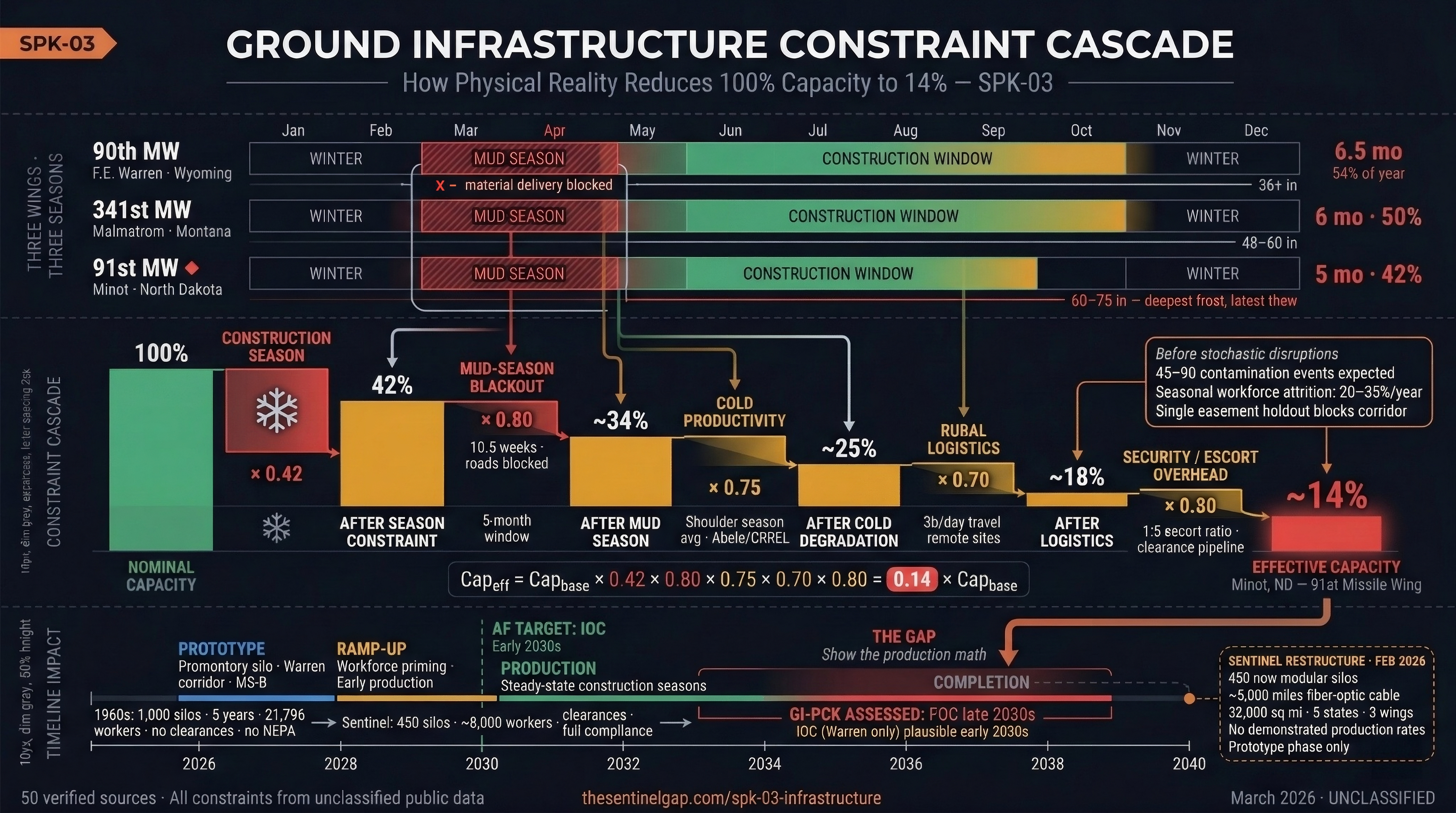
The LGM-35A Sentinel program's January 2024 critical Nunn-McCurdy breach was not driven by the missile system. It was driven by the ground. Total acquisition cost grew from $95.8 billion to $140.9 billion—an increase the Department of Defense attributed to the Command and Launch Segment: ground infrastructure, real estate, and fiber-optic communications. The Feb 2026 restructure commits 450 new modular silos, ~5,000 miles of fiber, and 32,000 sq mi across 5 states—but these assets must be built under unprecedented physical constraints. At the most constrained wing, these factors compound multiplicatively — reducing effective construction capacity to approximately 14–18% of nominal.
The Department of Defense reported in July 2024 that Sentinel triggered a critical Nunn-McCurdy breach across the full program. Vandenberg pilot revealed "unknown site conditions" posing "unacceptable risks to cost, schedule and weapon system performance".
Approximately 80% of cost growth originated from ground infrastructure, real estate, and fiber-optic communications. A "unit" in Sentinel's PAUC calculation includes one missile plus its allocated share of the entire weapon system infrastructure across three missile wings.
Three figures appear in public reporting. They represent different measurements of the same program: $77.7 billion is the original September 2020 Milestone B baseline in Base-Year 2020 dollars. $95.8 billion is the same baseline in Then-Year dollars, accounting for projected inflation — this is the figure used for Nunn-McCurdy breach calculation.[9] $140.9 billion is the revised total acquisition cost in Then-Year dollars, announced July 8, 2024.[1] As of March 2026, no new cost estimate reflecting the February 2026 restructure has been published.
Scope: 450 Launch Facilities (LFs), 45 Missile Alert Facilities (MAFs), 24 Launch Centers (LCs), 3 Missile Weapon Control Centers (MWCCs), thousands of miles of cabling, 32,000 sq mi across the 90th, 341st, and 91st Missile Wings.
A "unit" in the context of Sentinel's PAUC includes one missile plus its allocated share of the entire weapon system infrastructure. This includes the silo, command network, fiber segment, ground power, heating, environmental control, and launch system. The infrastructure allocation is proportional: 450 silos distributed across three geographically dispersed wings, each with independent command centers, utility corridors, and support facilities. Total infrastructure cost is divided by total unit count (659) to establish the per-unit baseline. This integrated definition is critical: if one component—say, fiber cabling—faces cost growth, that growth affects all 659 units' PAUC retroactively.
The original Sentinel plan was to refurbish 450 existing Minuteman III Launch Facilities (LFs). The February 2026 restructure abandons this approach entirely and commits to 450 new modular silos. Why? Three failure modes rendered refurbishment infeasible.
The Minuteman III weapon system—missile, guidance, and propellant—had an original design life of ten years.[11][12] The silo structures themselves were designed as enduring hardened assets, assessed at approximately 2,000 PSI overpressure resistance,[13][14] intended to host successive missile generations. They have been in continuous service for 60+ years—well beyond any reasonable structural expectation—subjected to water intrusion, freeze-thaw cycling, and aggressive environmental stressors that the original design did not anticipate at this duration.
Sentinel is slightly larger than Minuteman III. The missile has a larger bore diameter and different maintenance access points. Refurbished MM-III silos cannot be retrofitted to Sentinel's geometry without destroying the silo (cost ≈ new construction) and breaking nuclear surety during the process.
Minuteman III infrastructure contains five persistent hazardous materials. Refurbishment requires full remediation before new construction begins.
| Agent | Legacy Source | Location | Impact |
|---|---|---|---|
| PCBs | Transformers, hydraulic fluid, paint | LF floors, LSB, transformers | Concrete coring/testing; TSCA landfill disposal; precludes on-site crushing/reuse |
| Asbestos (Friable) | Thermal insulation, wiring, tiles | Generator rooms, launch tubes, LCCs | Negative pressure enclosures; reduced labor productivity; high PPE cost |
| Sodium Chromate | Cooling system inhibitor | Chiller rooms, sump drains, sub-floor soil | Carcinogenic (hexavalent chromium); deep soil sampling; groundwater plume risk |
| Lead (Pb) | Structural paint, batteries | Launch tube walls, LSB equipment | Lead abatement before torch-cutting; heavy metal disposal protocols |
| TCE | Cleaning solvents | Maintenance areas, subsurface plumes | Vapor intrusion risk; legacy plumes in dewatering streams |
Sources: GAO-10-547T, DoD DERP, Sentinel EIS.
The February 2026 restructure solves the geometric and contamination problems of refurbishment. It does not change the geography. Construction of 450 new silos across three geographically dispersed missile wings faces extraordinary seasonal and weather constraints. These are not manageable—they are structural bottlenecks.
| Wing | Location | Season | Duration | % Year |
|---|---|---|---|---|
| 90th MW | Cheyenne, WY | May 1–Nov 15 | 6.5 months | 54% |
| 341st MW | Great Falls, MT | May 1–Oct 31 | 6 months | 50% |
| 91st MW | Minot, ND | May 15–Oct 15 | 5 months | 42% |
Sources: USACE Omaha District, FHWA.
| Wing (Location) | Frost Depth | Thaw Date | Source |
|---|---|---|---|
| 91st MW (Minot) | 60–75 inches (5–6+ feet) | Mid-to-late May | Ward County/CRREL |
| 341st MW (Great Falls) | 48–60 inches | Early-to-mid May | Cascade County/CRREL |
| 90th MW (Cheyenne) | 36+ inches | Mid-April | Laramie County/CRREL |
| State | Restriction Period | Weight Limit | Notes |
|---|---|---|---|
| North Dakota | Early March–Mid-May (tiered) | Tiered 5/6/7/8-ton levels | 12,000–16,000 lbs single axle |
| Montana | February–Late May/June | 16,000 lbs single / 32,000 lbs tandem | NO Overweight Permits on restricted hwys |
| Wyoming | March–April (route-by-route) | 25–35% load reduction | Varies by highway class |
Sources: NDDOT, MDT, WYDOT.
| Wing (Location) | Blackout Period | Duration |
|---|---|---|
| 91st MW (Minot) | Mar 1–May 15 | 10.5 weeks |
| 341st MW (Malmstrom) | Mar 1–May 15 | 10.5 weeks |
| 90th MW (Warren) | Mar 1–May 1 | 9 weeks |
Abele 1986, CRREL SR 86-14 established labor productivity curves for cold-weather construction:
| Temperature Range | Productivity Factor | Conditions |
|---|---|---|
| >40°F | 0.95 | Minimal impact |
| 20–40°F | 0.80 | Gloves, slower pace |
| 0–20°F | 0.50 | 30 min work/30 min warm-up cycles |
| −10 to 0°F | 0.30 | Frostbite risk in minutes |
| Below −10°F | 0.10 | Effectively unworkable |
At Minot Air Force Base, winter wind speeds frequently reach 20 mph. A 10°F ambient temperature combined with 20 mph winds produces an effective (wind chill) temperature of approximately −9°F. At this condition, the CRREL productivity factor is ~0.30: a worker can perform only 30 minutes of effective labor before requiring 30 minutes of warming. A standard 8-hour construction shift yields ~2 hours of actual work equivalent. Concrete placement is impossible (fails ACI 306R standards below 50°F). Crane operations become extremely hazardous. This is not scheduling friction—it is a hard constraint.
ACI 306R[27][28][29] requires that concrete must be maintained at 50–55°F at placement and protected for 48–72 hours until it reaches 500 psi. If concrete freezes before reaching this threshold, water expansion fractures the internal matrix, permanently reducing strength by up to 50%. To pour concrete in conditions below 40°F, contractors must employ heated enclosures, insulated blankets, or heated mix designs—each adding cost, complexity, and schedule risk.
Note: North Dakota load restrictions as of March 3 and March 6, 2026, remain in active enforcement.
New construction sites on the existing missile wing footprints cannot escape legacy contamination. They occupy the same groundwater zones, share drainage patterns, and rest on soils disturbed by 60 years of military operations.
The GAO documented a 10–20% discovery rate for previously unknown contaminants at legacy military sites. Applied to 450 new sites, this projects 45–90 significant contamination discoveries during site characterization and early construction.
Each contamination event requires stop-work and remediation, causing 2–12 weeks delay and consuming remediation trade capacity.[17] The probability of encountering at least one major disruption across the program is approximately 100%.
The same five agents documented in Domino 1 will be encountered at new construction sites:
| Agent | Legacy Source | Location | Impact |
|---|---|---|---|
| PCBs | Transformers, hydraulic fluid, paint | LF floors, LSB, transformers | Concrete coring/testing; TSCA landfill disposal; precludes on-site crushing/reuse |
| Asbestos (Friable) | Thermal insulation, wiring, tiles | Generator rooms, launch tubes, LCCs | Negative pressure enclosures; reduced labor productivity; high PPE cost |
| Sodium Chromate | Cooling system inhibitor | Chiller rooms, sump drains, sub-floor soil | Carcinogenic (hexavalent chromium); deep soil sampling; groundwater plume risk |
| Lead (Pb) | Structural paint, batteries | Launch tube walls, LSB equipment | Lead abatement before torch-cutting; heavy metal disposal protocols |
| TCE | Cleaning solvents | Maintenance areas, subsurface plumes | Vapor intrusion risk; legacy plumes in dewatering streams |
Sources: DoD DERP, Sentinel EIS.
The restructure commits to ~5,000 miles of fiber-optic cabling spanning 32,000 sq mi across 5 states. This replaces legacy HICS copper networks (~7,500–8,000 miles) with a modern fiber backbone.
Fiber corridors require 16-foot permanent easements and 100-foot temporary construction easements.[30][31] USACE Omaha District Real Estate Division acts as purchasing agent. A single holdout parcel blocks an entire path—if any permit status is zero along a corridor, work on downstream segments and dependent connections is halted. While eminent domain is available as a last resort, the timeline for litigation far exceeds construction season windows.
Burial depth: 40 inches DoD minimum; 47–48 inches (1.2m) in agricultural areas. Installation rate: 1.5–3 miles/day/crew (FHWA/USDA baseline). This is achievable only during the same narrow construction window that constrains silo construction. Cabling requires completed civil works (grading, utility locating, joint trench coordination with power and water). Cabling is a hard dependency: without fiber, command and control infrastructure cannot be commissioned.
Construction of 450 silos and supporting infrastructure requires 2,500–3,000 personnel per missile wing. The local labor markets are insufficient. Bakken shale boom competition has depleted local capacity.
Unemployment rates:
During the 2007–2011 Bakken boom, aggregate average annual pay increased >50%. Competitors for skilled trades (ironworkers, electricians, HVAC) remain fierce. Sentinel requires Workforce Hubs: 50–60 acres per wing for imported workers—housing, dining, laundry, security badge processing, recreational facilities.
All construction workers on ICBM bases require Secret or Top Secret clearances. Processing times have exploded:
| Clearance Level | Processing Time (FY24 Q4) | Trend | Notes |
|---|---|---|---|
| Initial Secret | ~138 days (~4.5 months) | Elevated | PAC PMO FY24 Q4 data |
| Initial Top Secret | ~249 days (~8 months, fastest 90%) | Up 65% from FY24 Q1 | Peak of recent surge |
Sources: ClearanceJobs reporting;[39] GAO-26-108838.[40]
As of FY25 Q2, Top Secret processing times have partially stabilized near 206 days but remain well above the 114-day federal goal.[40]
Sources: ClearanceJobs, GAO-26-108838.
FY24 Q4 Top Secret processing reached 249 days (~8 months), far exceeding the federal goal of 114 days. The process has partially stabilized near 206 days but remains well above the 114-day federal goal. A worker hired in October may not be available until the following July, missing half the construction season.
Interim clearances expedite start dates but carry significant risk:
To yield 1,000 workers with final clearances, approximately 1,200 must be initiated on interim clearances (20–30% denial rate). This creates a buffer problem: rejected workers must be replaced, but a contractor hired today cannot work on a secure site for 4–8 months.
Escort ratio: 1 security escort per 5 general workers, 1:3 in sensitive areas.[42][43] Baseline annual turnover for construction is 20–30%, with recent aggregate peaks reaching 68%.[48] In remote, extreme-climate environments, some individual operations have documented turnover exceeding 100%.[48] Each wing must replace 500–1,050 workers per year through the clearance pipeline just to maintain steady state. At 249 days for Top Secret processing, replacements initiated in October may not be available until the following July, missing half the construction season.
No published study directly addresses the specific problem of reconstituting a seasonal construction workforce after a winter shutdown at a remote, security-cleared site.[48] This is an unmodeled constraint.
The production functions model workforce capacity as a level per period. In reality, the cleared construction workforce partially dissolves every winter and must be reconstituted every spring.
The mechanism is straightforward. Construction stops in October (Minot) or November (Warren). Workers housed in temporary man-camps in remote Northern Great Plains locations will not remain idle for 5–7 months in one of the coldest inhabited regions on the continent. They return home. They take construction jobs in warmer climates—Gulf Coast refineries, Texas data centers, Southern infrastructure projects. Their clearances travel with them; they are immediately employable on other cleared work.
The rational contractor response is to over-initiate clearances, processing perhaps 150–160% of the target workforce to account for interim denials (20–30%), winter attrition (20–40%), and no-shows. This creates surge demand on a clearance pipeline already processing above federal goals.[40] The system was not designed for massive seasonal pulses of speculative applications from a single program.
The seasonal workforce cycle means Cap_base does not hold steady from year to year. Each spring, the workforce starts below the prior season's peak. It ramps through June and July as returnees arrive and new clearances complete. It peaks in August. It ramps down in September–October. The effective steady-state window—peak workforce during peak weather—may be as narrow as 8–12 weeks per season at the most constrained wings.
GI-PCK incorporates a workforce retention factor: Cap_base(τ_spring, wing) = Cap_base(τ_peak_prior, wing) × f_retention. If f_retention is 0.65–0.80 (20–35% annual loss), each wing must replace 500–1,050 workers per year through the clearance pipeline just to maintain steady state—before any planned growth.
This creates a feedback loop: seasonal dissolution creates clearance pipeline demand, which slows processing, which means fewer workers ready by spring, which extends the program, which means more winter cycles, which means more attrition.
The constraints documented in Dominoes 2–5 are not independent. They compound multiplicatively. At Minot (the most constrained wing), effective construction capacity collapses.
| Constraint | Factor | Description |
|---|---|---|
| Construction Season | 0.42 | 5 of 12 months (May 15–Oct 15) |
| Mud-Season Blackout | ~0.80 | 10.5 weeks lost from season window |
| Cold Productivity (Shoulder Avg) | ~0.75 | Abele methodology, interpolated across season |
| Rural Logistics Overhead | 0.70 | 3h/day travel, equipment staging, supply delays |
| Security/Escort Overhead | ~0.80 | 1:5 escort ratio, badge processing, access control |
| PRODUCT | ~0.14 (14%) | 0.42 × 0.80 × 0.75 × 0.70 × 0.80 |
At the most constrained wing (Minot, North Dakota), effective construction capacity is approximately 14–18% of nominal after all factors compound. For every dollar of construction capability budgeted, approximately fourteen cents of actual production is realized at the hardest wing.
DESR 6055.09, AFMAN 91-201, and related DoE physical protection requirements mandate:
The 1,200-foot standoff is physically manageable given that existing Minuteman III silos are typically spaced miles apart within each missile field. New silos on government-owned land can be positioned beyond the QD arc of operational weapons. However, the constraint must be explicitly incorporated into construction planning—site selection, equipment staging, and crew work zones must all respect the safety arc. An unresolved administrative question exists: if construction crews are classified as "mission related" personnel, the applicable standoff distance could potentially shrink to Intraline Distance (ILD) rather than full IBD.[44] This determination has not been publicly documented.
The February 2026 restructure introduced a structural question: can new modular silos be built on adjacent government land while existing Minuteman III silos remain armed and operational? The 1,200-foot IBD standoff is physically manageable given that silos are spaced miles apart — new construction can be positioned beyond the QD arc. However, the construction activity itself creates security demands that intersect with SPK-07's transition model.
SPK-07 documents approximately 800 nuclear convoys required over ~9 years to transfer warheads from Minuteman III to Sentinel. These convoys move through the same missile fields where construction crews are operating. Construction sites within the field require security posture changes, and the Security Forces surge for convoy operations occurs simultaneously with construction workforce presence.
If new silos are built before old silos go offline, SPK-07's 50-silo offline constraint may not bind during construction — only during missile transfer. But the interaction between construction sequencing and transition sequencing is a cross-spoke coordination problem that has not been publicly resolved. The question is not whether individual silos can be built at safe distances. The question is whether construction logistics, convoy security, and workforce movement can coexist within the same 32,000-square-mile operational theater without creating schedule conflicts that neither spoke models independently.
GI-PCK does not estimate costs (UC-BCK's domain, SPK-01) or produce schedules (SI-CK's domain, SPK-02). It validates whether proposed ground infrastructure production plans are physically feasible given capacity constraints.
To measure whether the 450-silo restructure can meet its timeline and cost targets, the Air Force requires a machine-readable, reproducible production closure kernel: GI-PCK. This framework encompasses four technical artifacts.
This artifact classifies each facility into condition bins (F0–F4) based on structural assessment, geometric compatibility, HAZMAT burden, easement status, and logistics cost:
NEW_BUILD_SHARE ≈ 1.0: All 450 facilities are new construction (zero refurbishment).
Encode production constraints as rule sets:
Model effective construction capacity as:
Where:
Cross-spoke dependencies are modeled as constraints:
Nine gates that GI-PCK must satisfy before deployment:
All GI-PCK components use mature technologies (TRL 9): rule engines and decision tables, linear/mixed-integer programming (LP/MIP), Monte Carlo simulation, and graph algorithms (CPM, corridor reachability). No component requires research-grade algorithms. Computational requirements are modest: O(10³) facilities, O(10²) corridor segments, execution time well under one minute per validation run.
The Air Force targets Initial Operational Capability (IOC) in the early 2030s. Is this feasible?
In the 1960s, USACE built approximately 1,000 Minuteman silos in 5 years (~160–200/year). At Minot alone, 150 silos were constructed in 28 months (~64/year at one wing). Peak workforce: 21,796 (CEBMCO).
However, conditions were dramatically different. Temperatures dropped to −35°F, which "severely tested worker endurance". Spring thaws and heavy rains turned sites into "quagmires". Yet progress was rapid because:
| Factor | 1960s Minuteman | Sentinel (2026–early 2030s) |
|---|---|---|
| Security Clearances | Minimal | 5–12 months; 1 in 4 denied interim |
| Labor Market | Surplus labor; large, unionized, mobile workforce | 500,000 shortage nationwide; Bakken competition |
| Workforce Density | 21,796 peak (~7,000/wing) | 2,500–3,000/wing (2.5× lower) |
| Environmental | None (pre-NEPA, pre-EPA, pre-RCRA) | Full compliance required (EIS, RCRA, NEPA) |
| Contamination | N/A (new construction) | 45–90 events expected |
| Predecessor Demolition | N/A (new sites) | 450 legacy silos must be decommissioned |
| System Complexity | Simpler (hardline) | Fiber, advanced C2, cyber-surety |
Conclusion: Production construction cannot begin before 2028. This leaves 5–6 construction seasons before early 2030s IOC. At effective capacity ~14–18% of nominal (Minot constraint), completing all 450 silos across three wings is not feasible in this window.
The Sentinel ground infrastructure production challenge is unprecedented in scope and constraint intensity:
Approximately 80% of Sentinel's cost breach originated in ground infrastructure. The construction constraints, modular silo challenges, and labor bottlenecks documented in SPK-03 are the physical root cause of the cost growth that UC-BCK measures.
SI-CK models missile development and test milestones. Those milestones consume GI-PCK's construction windows as bounding functions. Slip in SI-CK directly reduces available months for facility production.
The fiber overlay depends on utility corridor completion (GI-PCK). NC3 interface validation gates cannot close until facility outfitting is complete and command network can be tested end-to-end.
Digital surety validation gates must precede facility outfitting. GI-PCK's acceptance criteria include cyber-surety as a hard constraint: facilities cannot be energized until security certification is complete.
Test infrastructure (launch facilities, command centers, fiber) must be built within GI-PCK's constraint envelope. Test infrastructure production cannot exceed overall GI-PCK capacity.
Worker importation, clearance processing, Bakken market competition, and seasonal turnover are consumed as bounding functions in GI-PCK's capacity model. Workforce constraints are the primary driver of the 14–18% effective capacity ceiling.
GI-PCK must satisfy nine acceptance criteria to provide reproducible evidence for production closure. All remain unmet as of the current date.